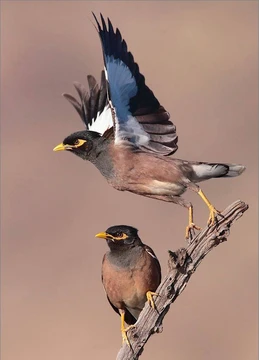
Vasa parrot
Four parrot species endemic to Madagascar and nearby islands.

Wikipedia / Wikimedia Commons
The vasa parrots are four species in the genus *Coracopsis*, part of the parrot family Psittrichasiidae. They are found only on Madagascar and nearby islands in the western Indian Ocean. The name "vasa parrot" is a common name for the genus *Coracopsis*, which includes both the greater vasa parrot (*Coracopsis vasa*) and the lesser vasa parrot (*Coracopsis nigra*), among others, so it applies to all species, not just the greater. German ornithologist Johann Georg Wagler introduced the genus *Coracopsis* in 1832, with George Robert Gray designating the lesser vasa parrot as the type species in 1840. Some taxonomists once placed these birds in the genus *Mascarinus*, but that classification was historically based on morphological similarities, not solely a genetic study. A 2011 genetic study suggested a relationship, but later research (e.g., by Hume and others) argued against it due to contamination, not that the original classification was based on a flawed genetic study.
A 2011 genetic study suggested the Mascarene parrot from Réunion was nested among lesser vasa parrot subspecies, diverging 4.6 to 9 million years ago—before Réunion existed—implying the split happened elsewhere. However, later research indicated this placement likely resulted from cross-contamination of genetic material, debunking it and supporting the two as distinct, unrelated genera in different subfamilies.
Vasa parrots have a striking appearance: extremely short bodies, long necks, black to grey feathers, and a pink beak. During breeding season, the skin of both males and females turns yellow, and they often lose feathers—females may become completely bald. Another unusual trait is that a female’s normally black to grey feathers can turn brown without molting, due to a redistribution of melanin.
Their physiology is unique among parrots. Vasa chicks hatch after only 18–20 days of incubation, far shorter than the typical 30 days for parrots of similar size. The male’s cloaca can evert into a hemipenis that becomes erect during mating—a feature unique to the genus—and is associated with prolonged matings and a copulatory tie. Baby vasas have pads on their beaks that, when stimulated, trigger a strong feeding response; these pads disappear after a few weeks, but the feeding reflex remains unusually strong into adulthood, often requiring aviculturalists to use a syringe to force food int
- Genus
- Coracopsis
- Family
- Psittrichasiidae
- Endemic to
- Madagascar and other islands in the western Indian Ocean
- Number of species
- 4
- Notable for
- Peculiar appearance, unique reproductive physiology
- Incubation period
- 18–20 days
Lore & Background
The genus Coracopsis was introduced in 1832 by German ornithologist Johann Georg Wagler, with the type species designated as the lesser vasa parrot by George Robert Gray in 1840. Some taxonomists formerly placed the species in the genus Mascarinus, but this classification was historically based on morphological similarities, not solely a genetic study. A 2011 genetic study found the Mascarene parrot from Réunion to be nested among subspecies of the lesser vasa parrot, but later research indicated this placement likely resulted from cross-contamination of genetic material, supporting them as distinct genera within different subfamilies.
Reader's Guide
The vasa parrots hold significance in ornithology due to several unique physiological traits. Their incubation period of only 18–20 days is highly irregular for parrots of their size, which typically take up to 30 days. Male vasas possess a cloaca that can evert into a hemipenis, a feature unique to the genus, associated with prolonged matings enforced by a copulatory tie. During breeding season, the skin of both sexes turns yellow, and females may experience complete baldness and a change in feather color from black to brown due to melanin redistribution. Baby vasas have beak pads that prompt a strong feeding response, and the weaning reflex remains unusually strong into adulthood, sometimes requiring syringe feeding. Additionally, vasa parrots infected with psittacine beak and feather disease turn white, leading to mistaken advertising as albinos during the 1970s.
Did You Know?
- Vasa chicks hatch after only 18–20 days of incubation, much shorter than the typical 30 days for parrots of similar size.
- During breeding season, female vasa parrots may become completely bald, and their normally black to grey feathers can turn brown without molting due to a redistribution of melanin.
- Male vasa parrots have a unique cloaca that can evert into a hemipenis, associated with prolonged matings and a copulatory tie.
Frequently Asked Questions
What is the Vasa parrot?
The Vasa parrot is a group of four parrot species in the genus Coracopsis, belonging to the family Psittrichasiidae. They are found exclusively on Madagascar and surrounding islands in the western Indian Ocean, and the common name also refers specifically to the greater vasa parrot.
What makes the Vasa parrot stand out from other parrots?
These birds are noted for their striking, unusual physical appearance combined with a distinctive reproductive physiology that sets them apart from most other parrot species. Their eggs require roughly 18 to 20 days of incubation.
How many species belong to the Vasa parrot group?
There are four recognized species within the genus Coracopsis. All of them are endemic to Madagascar and nearby islands, so you will not encounter them on any other landmass.
Who first classified the Vasa parrot and when?
German ornithologist Johann Georg Wagler established the genus Coracopsis in 1832. A few years later, in 1840, George Robert Gray designated the lesser vasa parrot as the type species for the group.
Was the Vasa parrot ever assigned to a different genus?
Yes, some taxonomists at one point placed these birds under the genus Mascarinus based on a genetic study. That reclassification was later overturned after the underlying genetic work was shown to be flawed.
More in Birds of the Indian Ocean 1-24
Spotted an error? Know more?
This is a living reference — every entry is fact-audited, and reader corrections feed straight into our audit queue. Suggest an edit · See this site's audit record